

Chlorodesmis fastigiata: the toxic green alga that should not be underestimated
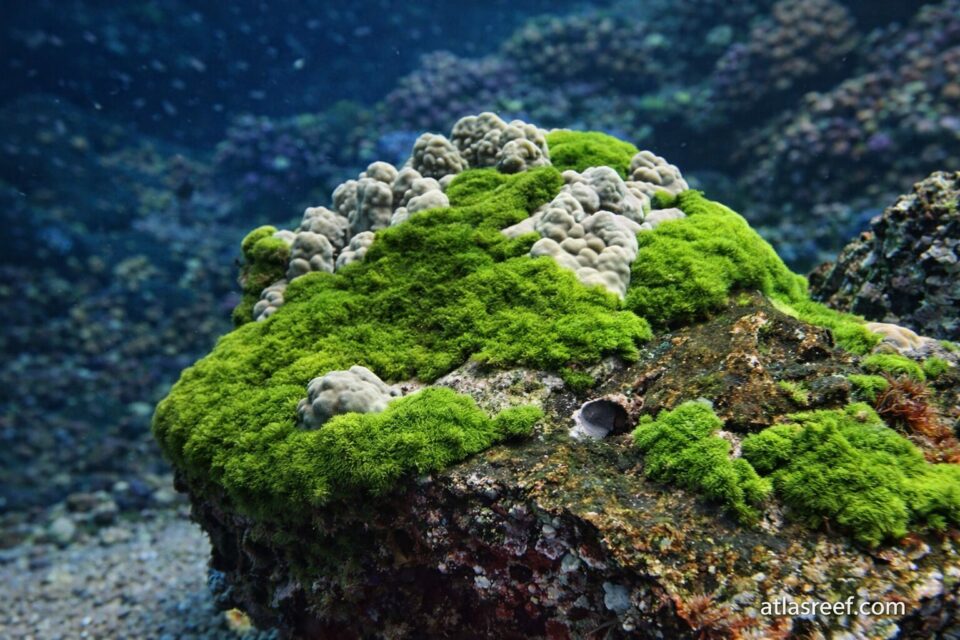
Chlorodesmis fastigiata, known in English as turtle weed, is not a simple patch of green hair algae. Visually it may look like a fine, neat and even attractive mat; biologically, however, it is a chemically defended macroalga, unpalatable to many herbivores and potentially aggressive when it comes into contact with coral.
Quick facts
- Type: thin, dense, filamentous green macroalga.
- Main risk: contact with corals + chemical defense.
- Common confusion: Bryopsis or generic green hair algae.
- Control: Early removal, nutrient export, biological competition and surveillance.
Risk for corals: high with direct contact
Control difficulty: medium-high
Palatability: low for many fish
System signal: persistent imbalance
AtlasReef experience “The mistake is not seeing a small green mat. The mistake is to think that, because it is small, the chemical environment around the coral is not changing.”
Introduction: a small alga with a big message

In marine aquariums, many green algae are interpreted as “excess nutrients” and little more. With Chlorodesmis fastigiata, that interpretation falls short. It is an organism that combines localized growth, chemical defense and low acceptance by many generalist herbivores.
That does not mean that each outbreak is a catastrophe. It means that it is appropriate to act while the mat is still small, before it is consolidated in crevices, touches a coral or becomes an established part of the aquascape.
Identification: how to recognize Chlorodesmis fastigiata


| Trait | What Is Observed | Practical interpretation |
|---|---|---|
| Texture | Very thin, soft, silky hair-like filaments. | More orderly and uniform than chaotic hair algae. |
| Colour | Intense green to emerald green. | It can look “healthy” and attractive, which delays the response. |
| Form of growth | Dense mats growing from the rock. | The attached base is the critical point during removal. |
| Location | Cracks, live rock, lighted areas with moderate flow. | If it touches a coral, it’s no longer an aesthetic problem. |
Biology: why it doesn’t behave like ordinary hair algae
Chlorodesmis fastigiata is a green macroalga of tropical reefs. In nature it forms visible patches on hard substrates and participates in a complex ecological network: herbivores that avoid it, specialized organisms that consume it and corals that can suffer when physical and chemical contact is maintained.
What matters to the aquarist
- It doesn’t always disappear by dropping nutrients for a week.
- It can resist better than more palatable algae if herbivores avoid it.
- Contact with coral is more relevant than the size of the mat.
- Its appearance indicates an ecological window: light, free surface, available nutrients and little competition.
AtlasReef interpretation
The aquarium is not “dirty” simply because it appears. The situation is more nuanced: there is room, energy and too little ecological pressure for that alga to hold its ground. The goal is not to sterilize the system, but to close that window.
Toxicity and chemical warfare: the reason why it deserves its own guide

The word “toxic” should not be used to create panic, but to explain why many fish do not devour it as they would other algae. Chlorodesmis contains defensive compounds, including diterpene-type metabolites, which may deter herbivores and affect neighboring organisms.
On reefs and in aquariums, the critical point is the direct contact. A mat growing several inches from a coral is not the same as a mat rubbing against living tissue. The first should be monitored; the second requires intervention.

Why it appears even if “the parameters are good”

A normal test result does not prove that the system does not have algae fuel. There may be phosphate linked to rock, microzones with detritus, feeding pulses, dissolved organic matter or insufficient biological competition. The alga does not read your test; it responds to the ecosystem.
AtlasReef experience “When Chlorodesmis appears, don’t ask just ‘how much nitrate I have.’ Ask what corner of the system is giving it an advantage.”
Visual comparison: Chlorodesmis vs Bryopsis vs green hair algae

| Algae | Appearance | Main risk | Recommended response |
|---|---|---|---|
| Chlorodesmis fastigiata | Fine, silky, uniform green. | Chemical and physical contact with corals and low palatability. | Early removal + ecological control + surveillance. |
| Bryopsis pennata | Feathery or branched structure. | Regrowth from base and persistent propagation. | Accurate identification, careful removal and specific strategy. |
| Green hair algae | More chaotic and long filaments. | Competition for space and nutrient/light signal. | Export, herbivores, flow, maintenance and competition. |
Realistic control: how to act without breaking the aquarium
Phase 1 — Small shoot
- Turn off the pumps during removal.
- Remove it with tweezers, trying to get the base out.
- Siphon loose fragments immediately.
- Check the same point every 3-4 days.
Best time to win
Phase 2 — Established patch
- Remove it manually in stages without crushing it.
- Reposition corals if there is direct contact.
- Gradually increase the export of nutrients.
- Reduce debris build-up in the area.
Requires follow-up
Phase 3 — Repeated outbreaks
- Look for local cause: nutrient-nutrient-loaded rock, dead zone, excessive localized light.
- Don’t make extreme water changes out of anxiety.
- Reinforce competition: healthy corals, coralline algae, refugium, consistent maintenance.
- Document with weekly photos to see real trend.
It’s not just aesthetic anymore.
Phase 4 — Coral contact
- Prioritize separating living tissue from algae.
- Trim or remove the alga while minimizing loose fragments.
- Siphon and place activated carbon if broader chemical stress is suspected.
- Observe polyp extension and tissue margins for several days.
Priority action
It worked / It didn’t work
It worked.
- Early manual removal, with siphon and pumps off.
- Reduce local debris without destabilizing the entire reef.
- Separate corals before there is a clear recession.
- Improve export progressively, not aggressively.
It didn’t work.
- Wait for “some fish to eat it.”
- Remove it and leave fragments in the aquarium.
- Lower nutrients to zero and punish corals.
- Confuse it with normal filamentous and delay the intervention.
Animals that Can Help: Real Expectations
The uncomfortable part: many aquarium herbivores do not show a clear preference for Chlorodesmis fastigiata. The reef literature describes chemical defenses and low palatability for numerous fish. There are organisms specialized in nature, but they are not a standard solution for the domestic aquarium.
| Animal | Reliability | Honest comment |
|---|---|---|
| Rabbitfish / Siganus spp. | Conditional | Some siganids consume hard or defended macroalgae, but results vary between individuals. |
| Tangs / Zebrasoma, Ctenochaetus, Acanthurus | Variable | They can help with algae and biofilm, but should not be sold as a specific solution for Chlorodesmis. |
| Sea urchins | Variable | Good general scrapers; they can dislodge objects and do not always consume this alga. |
| Crabs/Associated specialists | Not practical | There are specialized natural relationships, but they are not a regular, traceable and safe tool in home reef aquariums. |
Common errors
1. Call it “generic generic generic green fuzz”
If the identification fails, the strategy fails. Chlorodesmis requires more attention when it’s near coral.
2. Lower nutrients to zero
The aquarium may seem cleaner, but corals lose resilience. The solution should not punish the system.
3. Start without siphoning
Fragmenting algae into suspension converts a removal into a distribution of material throughout the aquarium.
4. Trust a miracle fish
Biological control works best as maintenance, not as late rescue.
Scientific evidence and ecological basis
The available evidence does not speak of “aquarium recipes”, but of reef ecology: coral–macroalga competition, chemical defenses, selective herbivory and specialized organisms. This information, applied with caution, explains why this alga should not be treated as a generic hair algae.
Alga–coral contact and tissue damage
Rasher and collaborators showed that numerous macroalgae can cause whitening or death of coral tissue when they are protected from herbivores and remain in direct contact with corals.
Chemical cues and protective gobies
A study in Science described how corals threatened by Chlorodesmis fastigiata can emit chemical signals that attract associated gobies capable of removing algae.
Chemical defense and selective herbivory
The literature of chemical ecology describes Chlorodesmis as a low-preference food for many fish, with defensive compounds such as chlorodesmin involved in the deterrence of herbivores.
Biological identity and distribution
SeaLifeBase lists the species under the name Chlorodesmis fastigiata and its common name “turtle weed”.
Recommended readings AtlasReef
To understand the problem as a system, not as “an isolated green patch”:
FAQ: Frequently Asked Questions
Is Chlorodesmis fastigiata the same as green hair algae?
No. It may look like fine hair algae, but it has a different ecological identity: a more uniform mat, chemical defense and low palatability to many herbivores.
Is it dangerous for all corals?
The highest risk appears with direct and prolonged contact. Fine tissue corals, SPS and growth edges can be especially vulnerable if the mat rubs against the tissue.
Which fish will eat it?
There is no reliable miracle fish. Some herbivores can peck it according to species and individual, but early manual removal remains the basis of control.
Should I turn off the light to eliminate it?
A blackout can weaken algae, but it also alters the system and does not eliminate the attached base. It is better to act on removal, detritus, export, competition and stability.
Can I leave it if it is away from the corals?
It can be monitored if it is very small and isolated, but it should not be allowed to consolidate. If it is near a coral, the recommendation changes: early removal.
AtlasReef conclusion: Chlorodesmis fastigiata teaches an uncomfortable lesson: not all green algae mean the same thing. Some merely make the aquarium look untidy. Others, in addition, change the chemistry at the boundary where a coral is trying to grow.
Images: AtlasReef Media Library. Credits: original/AI-generated royalty-free visual material, generated for editorial use in AtlasReef.